


How to Read Sheet Music: A Beginner’s Guide to Clefs and Notes

One of the coolest things about music is that it's a language that can be understood through a variation of pitches, melodies, and rhythms that somehow communicate things like emotions and cultural connections. Not only is music a language that can be understood by sound, but it is also a written language that you can learn to read. The symbols that you see on sheet music often represent things like pitch, rhythmic notation, playing style, and tempo. Lucky for you, this will serve as your all-inclusive guide on how to read this universal language!
To build a strong foundation in reading music, you should learn the most basic components of sheet music:
The Staff
The Clef
The notes
The staff is made up of 5 lines and 4 spaces, with each of these representing different notes that go from A-G. Each of these notes represents different pitches that move up the staff alphabetically.

Next up comes the clefs. There are three main clefs:
The G clef (Treble Clef) more commonly known as the Treble Clef
The F clef (Bass Clef) which refers to the bass clef
The C clef (Tenor and Alto Clef) which can stand for both the tenor and alto clef
Don’t worry, it sounds a lot more complicated than it actually is. These clefs are used for different pitch ranges for varying instruments and voices.
The Treble clef is used to notate higher pitches in music. So if you sing soprano, or play the violin or guitar, this is the clef you’re most likely going to be reading.

There are some easy mnemonics you can use to remember the notes on treble. To remember the note on the lines, you can use Every Good Boy Deserves Fudge. All you need to remember for the notes on the spaces is that space means face.
If those tricks don’t work, you can always remember that the curve that wraps around the second line makes it G.

The bass clef is used to notate the lower tones in music. Think tubas, bass guitars, baritone singers, and sometimes cellos (we’ll get back to that later).
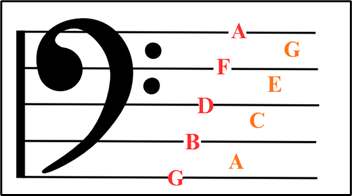
To memorize the notes on the lines on the Bass clef, you can use Good Burritos Don’t Fall Apart as a mnemonic to help you remember. And for the notes in the spaces, you can simply remember All Cows Eat Grass.
Again, if those tricks don’t work, you can always remember that the line between the two dots will always represent the note F.
Last but not least is the C clef. This works rather differently from its counterparts; you see, out of the three clefs, the C clef is the only one that acts as a movable symbol. It can be used as an alto to notate music for instruments like the viola. Or it can sometimes be used as a tenor clef to notate music for instruments such as the cello, bassoon, or even the trombone (see, I did say we would get back to it).


The best way to remember the notation for this clef is to remember that the middle of the clef will always refer to middle C.
Now, let’s put your knowledge to the test!
Grab a piece of sheet music and try identifying the clef and notes on your own. Stay tuned for more helpful tips and resources by connecting with FYAR.org through our website, social media, and more.
Happy reading, and keep practicing!


Comments